

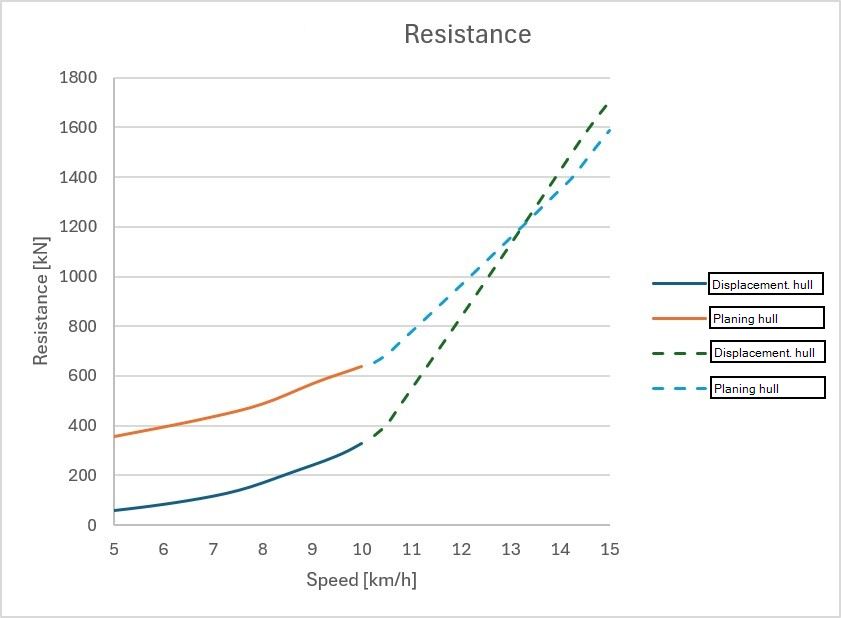
One of the most persistent challenges in yacht and small craft design is the mismatch between desired speed and realistic operational efficiency. Too often, hulls are optimised for a headline top speed that is rarely used in practice.
At Catran, we frequently see that the most efficient and successful vessels are not those with the highest theoretical top speed, but those whose hull form is aligned with their true operational profile.
This article explores how hull shape influences resistance, why design speed assumptions matter, and what happens when a vessel operates below or above its intended speed range.
1. The Core Principle: Hull Speed and Resistance Are Linked to Physics
A hull moves through water under the influence of several forms of resistance, including frictional resistance, wave-making resistance, and viscous effects. The relationship between speed and resistance is highly non-linear.
A key concept is the Froude Number, which relates vessel speed to waterline length. As speed increases, the vessel generates progressively larger wave systems. For displacement vessels, there comes a point where the power required to overcome these waves rises dramatically.
At this stage, designers must decide whether the vessel should remain a displacement hull, transition into a semi-displacement regime, or operate as a planing craft. The challenge is selecting the hull type that best matches the vessel's intended use.
2. Three Main Hull Types and Their Speed Reality
Displacement Hulls
Displacement hulls are designed for efficiency at moderate speeds.
Advantages include:
- Excellent fuel economy
- Predictable handling characteristics
- Efficient operation within their design speed range
- Comfortable motion in many sea conditions
However, attempting to exceed their intended speed range quickly leads to increased resistance and large power requirements.
Semi-Displacement Hulls
Semi-displacement hulls bridge the gap between displacement and planing designs.
Advantages include:
- Higher speeds than traditional displacement vessels
- Good versatility across a range of operating conditions
- Potential for efficient cruising when properly optimised
However, they require careful balancing of speed expectations, displacement, and power.
Planing Hulls
Planing hulls are designed to generate dynamic lift and rise partially out of the water at higher speeds.
Advantages include:
- High-speed capability
- Reduced resistance once fully on plane
- Excellent performance when operated as intended
At lower speeds, however, they can experience significantly higher resistance than other hull forms.
3. The Common Design Trap: Over-Optimising for Maximum Speed
Many projects begin with ambitious speed targets.
Clients may request:
- 30+ knot performance
- Long-range cruising capability
- Low fuel consumption
- Exceptional comfort
While all of these goals are desirable, they often compete with one another.
Hull efficiency is highly dependent on operating speed. If a vessel is optimised primarily for high-speed performance but spends most of its operational life at moderate cruising speeds, compromises begin to appear.
These may include:
- Increased wetted surface area
- Higher fuel consumption
- Less efficient trim characteristics
- Reduced overall efficiency
In many cases, the vessel carries the penalties of a speed capability that is only used occasionally.
4. What Happens When You Operate Below Design Speed
One of the most overlooked aspects of yacht design is performance away from the design point.
When a hull optimised for high-speed operation spends most of its life at lower speeds, several inefficiencies can arise.
Increased Frictional Resistance
At lower speeds, frictional resistance becomes the dominant component of total resistance. Hull forms with excessive wetted surface area will experience greater drag than necessary.
Reduced Dynamic Lift
Planing and semi-planing hulls often rely on dynamic lift to achieve their intended efficiency. At lower speeds, this lift is reduced, causing the hull to sit deeper in the water and increasing resistance.
Less Efficient Running Attitude
Hull forms developed for high-speed operation may not trim optimally at lower speeds, leading to further efficiency losses.
5. What Happens When You Push a Displacement Hull Too Fast
The opposite problem also occurs.
When a displacement hull is operated beyond its efficient speed range, wave-making resistance increases rapidly. The result is:
- Dramatic increases in required power
- Reduced fuel efficiency
- Larger bow and stern waves
- Increased operating costs
Simply installing larger engines rarely solves the problem. The hull form ultimately determines the vessel's efficient operating envelope.
6. The Most Important Question: What Speed Will the Vessel Actually Operate At?
The most valuable input during the design process is not maximum speed. It is the vessel's expected operating profile.
For many yachts and commercial vessels, a realistic breakdown may look something like:
- 60–70% of operating time at cruising speed
- 20–30% at low-speed manoeuvring or harbour operation
- Less than 10% at maximum speed
By understanding how a vessel will truly be used, designers can optimise the hull form for the speeds that matter most.
This often results in lower fuel consumption, improved comfort, better range, and reduced environmental impact.
7. Designing for Reality
An effective hull design process should evaluate:
- Resistance across the full speed range
- Propulsion efficiency
- Weight sensitivity
- Loading conditions
- Realistic operational profiles
The objective is not simply to achieve a target speed, but to create a vessel that performs efficiently throughout its operational life.
Conclusion
Hull shape is about far more than achieving a headline top speed. It determines how efficiently a vessel moves through the water every day of its life.
Designing around realistic operating requirements rather than occasional peak performance often produces better fuel efficiency, lower operating costs, improved comfort, and a more successful vessel overall.
The most effective designs are those that begin with a simple question:
How will the vessel actually be used?
Once that question is answered honestly, the right hull shape usually becomes much clearer.