
Finite Element Analysis (FEA) for Boats and Yachts
At Catran Naval Architect we deliver specialized Finite Element Analysis (FEA)services tailored to the unique demands of yacht design and marine engineering. Whether you're designing a high-performance racing yacht, refitting a classic cruiser, or validating structural changes, we help you move forward with confidence, precision, and peace of mind.
Beyond strength. Understanding how your vessel performs.
A vessel is more than a structure that needs to withstand the loads it encounters. It is an integrated system in which the hull, equipment, propulsion, sensors and onboard technology all need to work together reliably.
At Catran Naval Architects, we use Finite Element Analysis (FEA) to understand how structures and components behave under real operating conditions. From structural strength and weight optimisation to natural frequencies, forced vibrations, shock and air-blast loading, our analyses help turn engineering questions into informed design decisions.
Whether you are developing a high-speed motor yacht, a commercial vessel or an unmanned surface vessel (USV), we work with you to identify potential issues early, evaluate possible solutions and develop a design that meets its intended purpose.
Our approach combines engineering expertise with close collaboration. We listen to your objectives, understand the constraints of your project and work alongside your team to find practical solutions.
What can FEA tell us about your design?
Structural strength and weight optimisation
We analyse hull structures, decks, transoms, equipment foundations, brackets and other load-bearing components to understand stress distributions, deformations and load paths.
By identifying where material is working hard—and where it may be doing little useful work—we can help refine structural arrangements and material distribution. The objective is not simply to make a structure stronger, but to achieve the right balance between strength, weight, stiffness, durability and manufacturability.
Natural frequencies and vibration analysis
Every structure has natural frequencies at which it tends to vibrate. If these frequencies coincide with excitation from engines, propellers, machinery or other sources, unwanted resonance can occur.
Modal analysis helps us identify these frequencies and associated mode shapes. Combined with an understanding of the excitation sources, this information supports design decisions around structural stiffness, equipment mounting and vibration control.
For modern vessels, this can be particularly important where vibration affects not only comfort, but also the reliability and accuracy of sensitive equipment.
Forced vibrations and equipment integration
Knowing a structure's natural frequencies is only part of the picture. We can also investigate how it responds to specific dynamic forces.
Forced-vibration analysis helps assess vibration amplitudes and structural responses under defined operating conditions. This can support the design of machinery foundations, sensor mounts, equipment supports and other components where excessive movement or vibration could compromise performance.
Shock and air-blast loading
Some vessels and operating environments introduce loads that are very different from conventional static conditions. Sudden impacts, shock events and pressure waves can produce short-duration loads with potentially significant structural consequences.
Depending on the available loading information and the required level of analysis, FEA can help assess structural response, deformation and the potential effects on supporting structures and installed equipment.
The appropriate analysis method depends on the event being considered, the materials involved and whether nonlinear or transient effects need to be represented.
A collaborative approach to engineering
We believe the best engineering results emerge when the right expertise comes together early in the design process.
At Catran, FEA is not an isolated calculation delivered at the end of a project. It is a tool that can support decisions throughout concept development, detailed design, construction and modification.
We work with naval architects, designers, shipyards, equipment suppliers and other specialist engineers to understand the problem before selecting the analysis method.
That may mean checking a proposed structural arrangement, comparing alternative designs, investigating an unexpected vibration or helping a design team understand why a particular component needs to change.
We aim to make the results useful beyond the analysis itself. Our deliverables can include clear visualisations, stress and deformation plots, modal results, documented assumptions and practical recommendations that help your team decide what to do next.
We use Strand7 and SimScale to support our engineering work, selecting an appropriate approach for the geometry, materials, loading conditions and objectives of each project.
Case study: Structural analysis of a high-speed outboard vessel transom
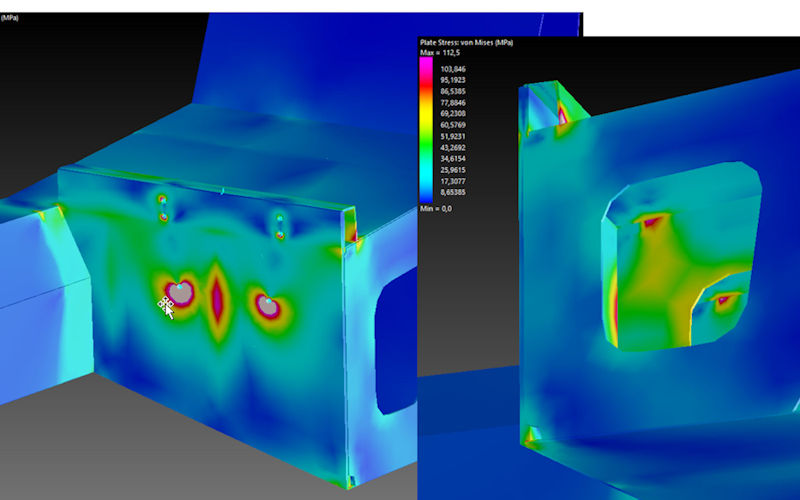
Understanding the loads behind the design
The transom of a high-speed outboard-powered vessel is an important structural interface. It transfers loads from the outboard installation into the surrounding hull structure while contributing to the overall stiffness and integrity of the aft section.
Working in collaboration with Sealevel Naval Architects, Catran applied FEA to the transom of a high-speed outboard vessel to support the structural design process.
The purpose of this type of assessment is to understand how the transom and its supporting structure respond to the relevant design loads, rather than relying on local reinforcement or additional material as the default solution.
An FEA model allows the structural arrangement to be assessed in more detail, helping identify areas of elevated stress, deformation and load concentration. The findings can then be considered alongside the vessel's intended operating profile, the outboard installation and the surrounding structural design.
This creates a useful basis for discussing potential refinements with the naval architecture team. Depending on the results, such refinements may involve local reinforcement, changes to load paths, adjustments to structural geometry or a review of the balance between stiffness, strength and weight.
Engineering through collaboration
The value of this work lies not only in the simulation, but also in how the results are used.
By combining Catran's structural analysis capabilities with Sealevel Naval Architects' involvement in the vessel design, FEA becomes part of a shared engineering process. The analysis supports the design team in evaluating structural behaviour and making informed decisions about the transom arrangement.
This is how we believe specialist engineering should work: bringing the right expertise together to address a specific technical question and help move the overall design forward.
Our FEA services
We provide finite element analysis support for new builds, design development and existing vessels, including:
Linear and nonlinear structural analysis.
Stress, deformation and load-path assessment.
Structural stiffness and weight optimisation.
Modal analysis and natural-frequency assessment.
Forced-vibration analysis.
Fatigue assessment where suitable loading data is available.
Shock and transient-response assessment.
Air-blast loading assessment where relevant to the project.
Equipment foundations, supports and mounting arrangements.
Structural modifications, refits and design verification.
The scope of each assessment is tailored to the engineering question, available information and applicable design requirements. Where formal approval or certification is required, the analysis approach and acceptance criteria should be agreed with the relevant stakeholders.
Let's work together
Do you have a structural challenge, an unexpected vibration or a design that needs further investigation?
Whether you are developing a new vessel, refining an existing structure or integrating sensitive equipment into a demanding marine environment, Catran can support your team with practical engineering analysis.
We start by listening to your requirements, understanding the problem and agreeing on the right approach.
Let's turn engineering questions into better design decisions.
Contact Catran Naval Architects to discuss your FEA project.
Frequently Asked Questions
FEA is a simulation method used to predict how structural components respond to physical forces like wave loads, wind pressure, and mechanical stresses. In yacht engineering, FEA is crucial for validating hull integrity, optimizing lightweight structures, ensuring compliance with classification standards, and improving safety and performance—all before a prototype hits the water.
- FEA can be applied to nearly every part of a yacht, including:
- Hull and deck structures under hydrodynamic and impact loads
- Keel and rudder assemblies under sailing or grounding conditions
- Bulkheads and internal frames for structural reinforcement
- Composite laminates and sandwich panels for material optimization
- Mast and rigging components under load cases like hoisting or sailing This allows for design refinements that enhance strength while reducing weight.
For us to start, you'll need to supply:
- 3D CAD models of the yacht or specific components
- Material specifications (e.g., composite layups, metals, core materials)
- Load cases and boundary conditions (e.g., wave loads, sailing forces, point loads)
- Design goals (e.g., weight savings, class compliance, safety margins) We’ll use this data to perform accurate simulations and provide actionable design feedback