
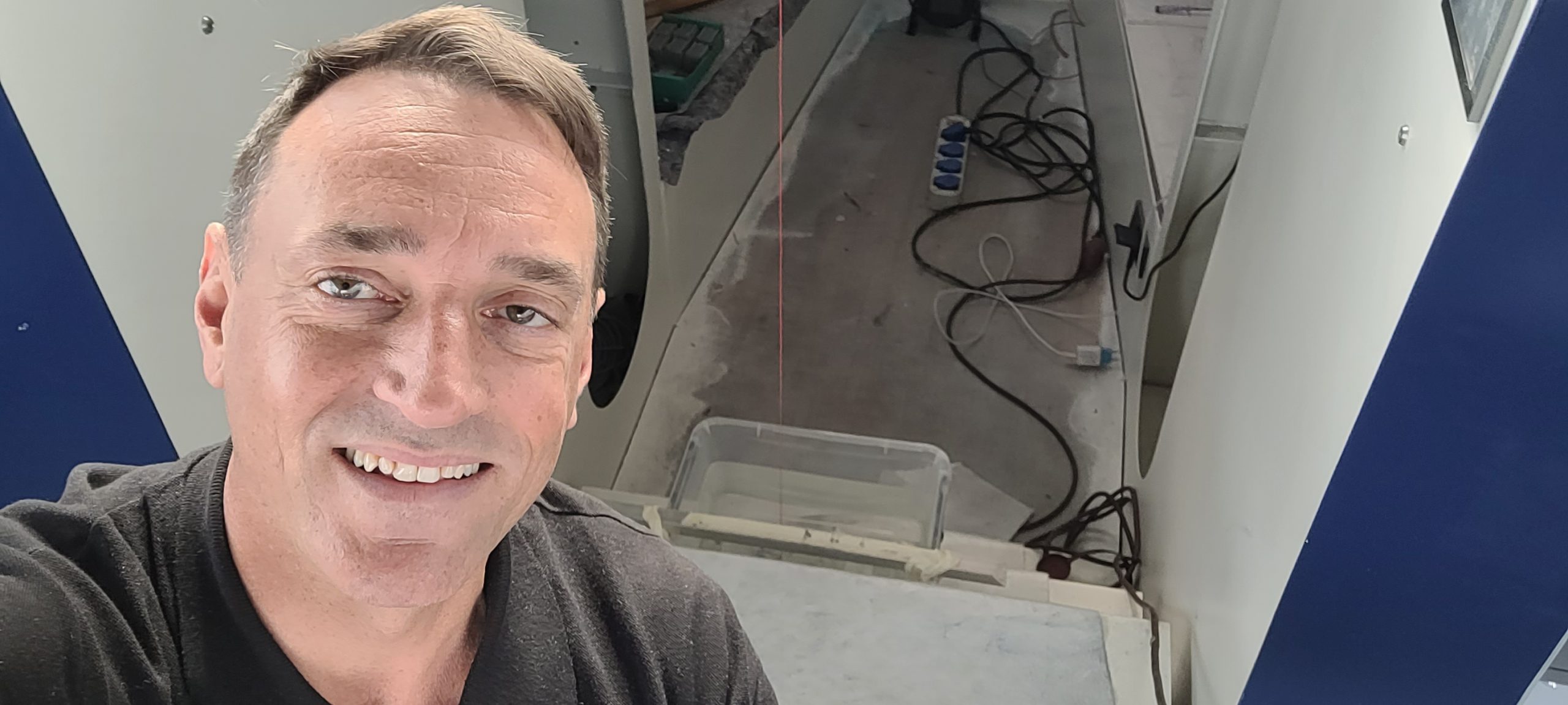

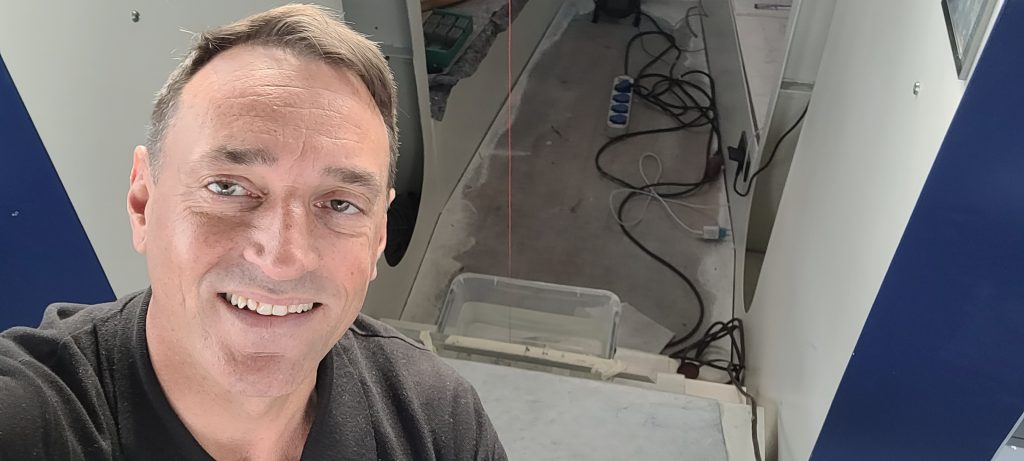
Last week, we had the opportunity to carry out an inclining test on the Cabin Tender 1100—one of those moments in a project where theory meets reality in a very tangible way. It’s a key milestone in the design and validation process, and, while it may not look particularly spectacular from the outside, it tells us a great deal about how a vessel will actually behave on the water.
For those unfamiliar, an inclining test is all about determining a vessel’s lightship weight and center of gravity. In simpler terms, we’re verifying how heavy the vessel really is and exactly where that weight is acting. Even with the most detailed design work and careful weight tracking throughout the build, there’s always a degree of uncertainty. The inclining test is where we confirm those assumptions with measured data.
A sheltered setup despite less-than-ideal conditions
We carried out the test in a well-sheltered location, though conditions were not entirely ideal. With around 10 knots of wind and a slight swell present, there were some external influences to account for. These factors are more important than they might seem. Wind and wave action can introduce noise into the measurements, so working in a protected area helped us minimise their impact and maintain a good level of accuracy.
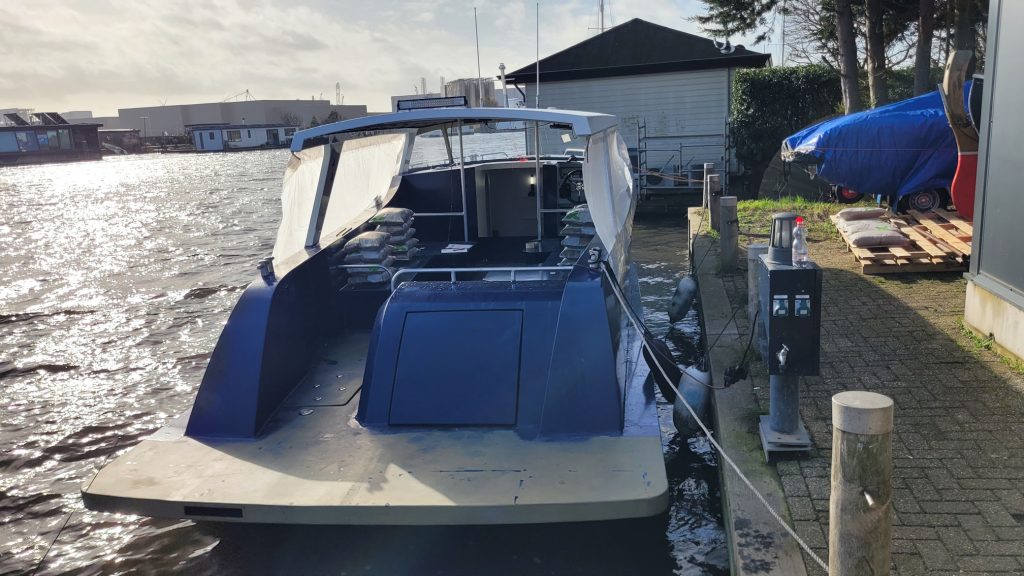
The Cabin Tender 1100 was prepared in its lightship condition, meaning all unnecessary items were removed: no loose equipment, minimal fluids onboard (aside from what’s required), and everything secured. This ensures we’re measuring the vessel in a standardized state that can be used reliably in stability calculations.
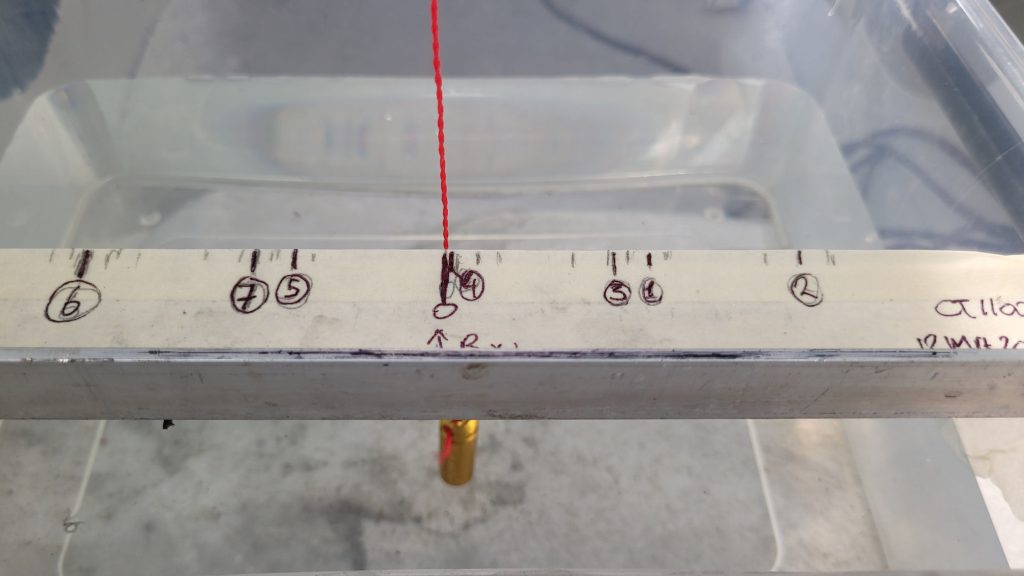
Once everything was ready, we established a reference system onboard to measure heel angles. This typically involves pendulums or digital inclinometers placed in carefully selected locations. For this test, we used a combination of both, allowing us to cross-check the data as we went.
Shifting weight, measuring response
The core of the inclining test is actually quite straightforward. Known weights are moved transversely across the deck, and we measure how much the vessel heels in response. By repeating this process several times—moving the weights port to starboard and back again—we build up a dataset that links applied moment to resulting heel angle.
On the Craftmanships Cabin Tender 1100, we used a series of calibrated weights that were shifted in predefined steps. Each movement was carefully recorded, along with the corresponding angle readings. Consistency is key here: the more repeatable the measurements, the more confidence we have in the final results.
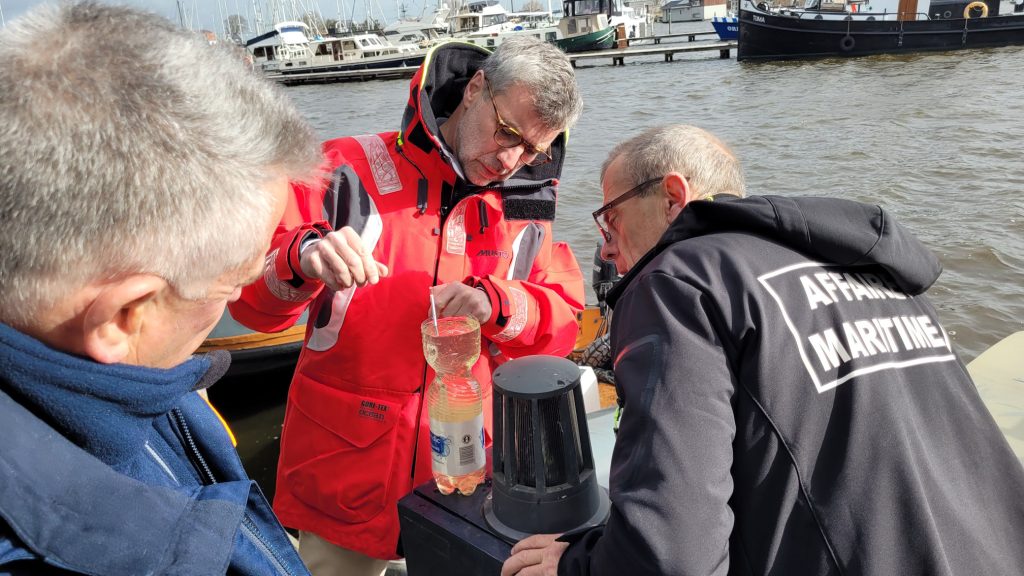
What’s interesting is that even small movements can produce measurable changes, especially on a vessel of this size. It’s a good reminder of how sensitive stability characteristics can be—and why precision matters so much in both design and verification.
From measurements to meaning
Once the physical test is complete, the real work begins back at the desk. The recorded data is processed to calculate the vessel’s metacentric height (GM), which is a primary indicator of initial stability. From there, we can determine the vertical center of gravity (VCG) and compare it to the design predictions.
For the Cabin Tender 1100, the results aligned well with our expectations. There were some minor deviations—there always are—but nothing outside acceptable margins. These small differences are valuable in themselves, as they allow us to refine our weight models and improve accuracy for future projects.
Why inclining tests matter
Inclining tests are a fundamental part of naval architecture, especially for vessels where stability is critical to safety and performance. While modern design tools and simulation software have become incredibly sophisticated, they still rely on input assumptions. The inclining test provides real-world data to validate those assumptions.
In many cases, regulatory bodies also require an inclining test before a vessel can be certified for operation. It forms the basis for the stability booklet, which defines safe operating limits, loading conditions, and operational guidance for the crew.
But beyond compliance, it’s about confidence. Knowing that a vessel behaves as expected—and having the data to back that up—is essential for owners, builders, and designers alike.
A satisfying milestone
There’s something quietly satisfying about an inclining test. It’s methodical, precise, and rooted in fundamental physics, yet it plays a crucial role in the bigger picture of bringing a vessel to life.
For the Cabin Tender 1100, this test marks another step forward—from design and construction toward operation. It’s always rewarding to see a project reach this stage and to confirm that the numbers we’ve worked with for months (or longer) hold true in reality.
As always, it’s a team effort. From the shipyard crew preparing the vessel, to the naval architects conducting the measurements, to the designers interpreting the results—everyone plays a part in making it a success.
FAQ: Inclining Tests
What is an inclining test?
An inclining test is an experiment conducted on a vessel to determine its weight and center of gravity by measuring its response to known shifted weights.
When is an inclining test performed?
Typically near the end of construction, before the vessel enters service, when it can be tested in a lightship condition.
Why is it necessary if the vessel was already designed in detail?
Even the most detailed designs rely on estimates. The inclining test verifies those assumptions with real-world measurements.
What is GM and why is it important?
GM, or metacentric height, is a measure of a vessel’s initial stability. A higher GM generally means the vessel is “stiffer,” while a lower GM indicates a more “tender” motion.
Can weather affect the results?
Yes. Wind, waves, and passing traffic can all influence measurements, which is why tests are performed in calm conditions whenever possible.
What happens if the results differ from expectations?
If differences are significant, the stability documentation is updated accordingly, and in some cases, design or operational adjustments may be required.
Is an inclining test required for all vessels?
Not all, but many commercial and regulated vessels require one as part of certification. For smaller or simpler vessels, alternative methods may sometimes be accepted.