

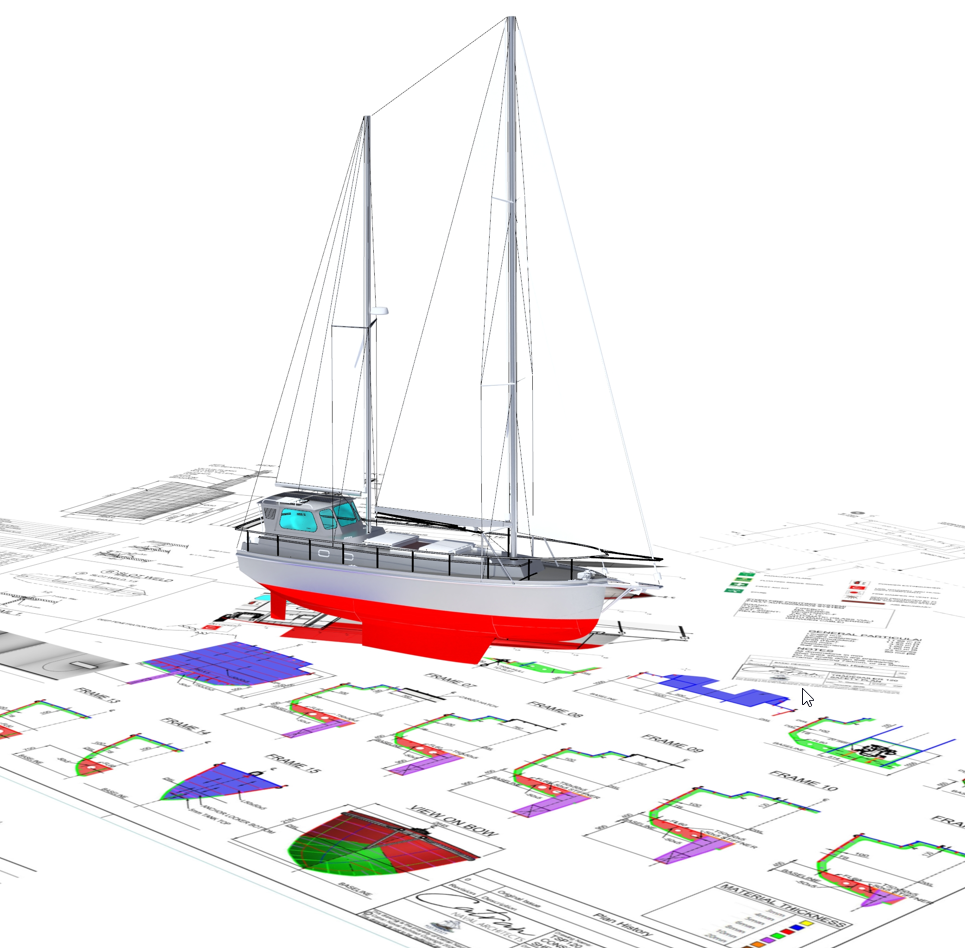
At first glance, not much.
One is a sailing cargo vessel designed for small ports and coastal communities. One is a small Italian city car. The other became one of the world's most recognisable cars.
Yet all three share an important idea:
They were designed to be useful rather than impressive.
The TradeSailer 120 is now entering the detailed design phase, and this philosophy is at the heart of the vessel we are developing.
There are boats designed to turn heads. They have sweeping lines, exotic materials and famous designers behind them. They are built in prestigious yards and photographed from every possible angle.
And then there are boats designed to do a job.
The TradeSailer 120 belongs firmly in the second category.
Designed for the real world
The Volkswagen Beetle and Fiat Panda were not created to be exclusive. Their success came from being practical, affordable and usable by ordinary people.
They could be driven almost anywhere, maintained without a specialist factory and adapted to the realities of everyday life.
The TradeSailer 120 follows a similar philosophy.
It isn't designed to be the most spectacular vessel in the harbour. It isn't dependent on a famous designer or the world's most prestigious shipyard.
It is designed around a much more important question:
What does a small cargo vessel actually need to do to make a difference?
The answer is surprisingly simple.
It needs to carry cargo, operate economically, access places that larger vessels cannot and be practical for the people actually operating it.
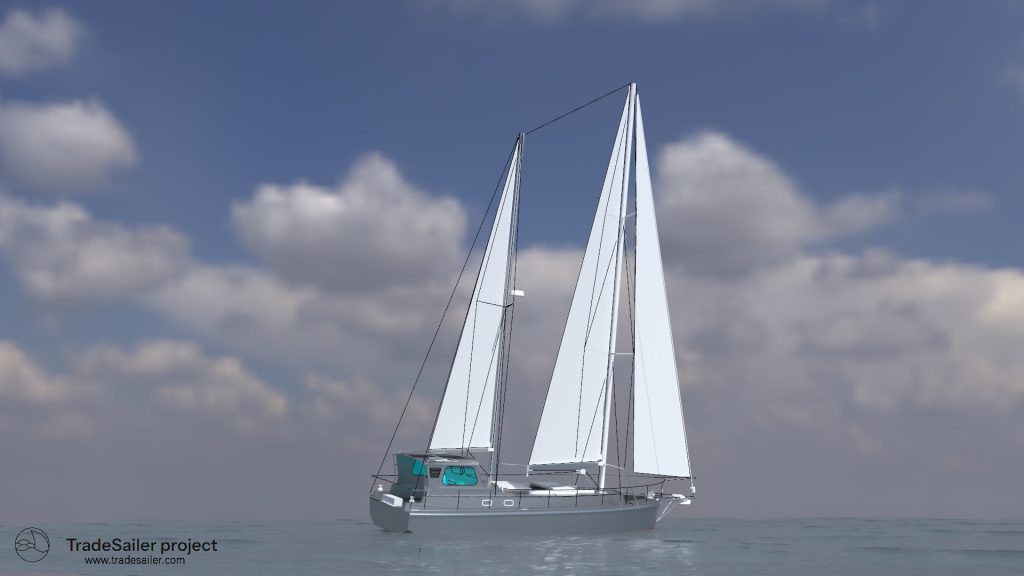
Seven tonnes. Two people.
The target for the TradeSailer 120 is around 7 tonnes of cargo capacity, operated by a crew of two with minimal qualification requirements.
That combination is important.
A vessel can be technologically impressive, but if operating it requires a large crew with specialist qualifications, its usefulness can quickly become limited.
The TradeSailer 120 is being developed with accessibility in mind.
It is intended to be a working vessel that can be operated in different countries and by smaller organisations, businesses and communities.
And then there is the crane boom.
The vessel will be capable of self-loading cargo of up to a SWL of 250 kg, reducing dependence on shore-based cranes or additional handling equipment for smaller loads.
That may sound like a small feature.
For a small coastal community, it could make a very big difference.
What if the port doesn't have a crane?
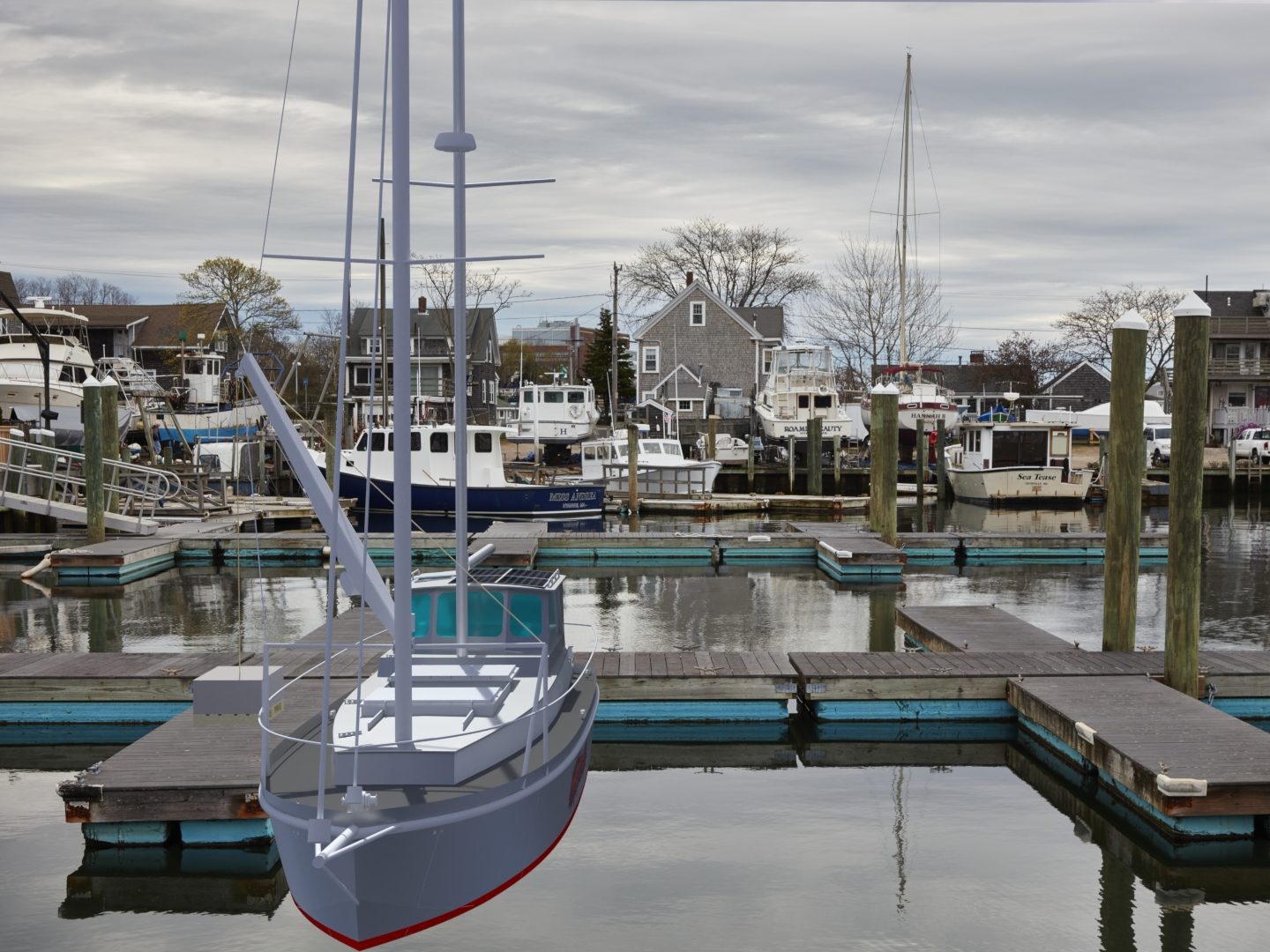
This is where the TradeSailer 120 starts to become interesting.
Modern shipping often assumes a considerable amount of infrastructure.
Large vessels need deep water. Cargo vessels need quays. Ports need cranes. Containers need handling equipment.
But what happens when the community you want to serve has none of that?
Perhaps the answer isn't always to build a bigger port.
Perhaps we should build vessels that can work with what is already there.
The TradeSailer 120 is small enough to access ports, marinas and coastal locations that are inaccessible to larger commercial vessels.
Its ability to handle smaller cargoes independently means that a small marina or harbour could potentially become part of a wider shipping network.
The vessel brings the logistics capability with it.
That opens up an interesting possibility: turning small ports into small shipping hubs without first having to transform them into major commercial ports.
Sailing because it makes sense
The TradeSailer 120 is also part of a wider rethink of coastal transportation.
Wind propulsion isn't new. In fact, it is one of the oldest forms of commercial maritime transport.
What is new is the technology we can combine with it.
Modern materials, weather forecasting, navigation, efficient auxiliary propulsion and better understanding of vessel performance allow us to revisit sail freight with a very different toolbox.
The goal isn't to suggest that wind can replace every conventional cargo vessel.
It is much more practical than that.
Use wind when it makes sense.
Reduce fuel consumption. Reduce exposure to fuel price volatility. And create a vessel that can continue to perform in a world where low-carbon transport is becoming increasingly important.
Built through collaboration
The TradeSailer 120 is being developed in partnership with Bay State Sail Freight and the Center for Post Carbon Logistics.
This collaboration is important because this project is about more than naval architecture.
The real challenge is the system around the vessel: the cargo, the ports, the operators, the communities and the economics.
A technically brilliant boat that nobody can afford to operate isn't a successful solution.
A sustainable vessel that requires expensive port infrastructure isn't a complete solution either.
The TradeSailer 120 is therefore being developed around a simple principle:
Make the vessel practical first.
A design others can use
There is another important difference with the TradeSailer 120.
The ambition is not to create a proprietary vessel that only one company can build or operate.
The design will be accessible to people and organisations who want to use this type of vessel to create meaningful change in their own region.
Because the transition towards more sustainable maritime transport won't be achieved by one company, one designer or one shipyard.
It will happen when practical ideas are shared, adapted and put to work.
Nothing flashy. Just useful.
The TradeSailer 120 probably won't be the most glamorous boat in the harbour.
And that's exactly the point.
It doesn't need to be.
If it can carry seven tonnes of cargo with two people, access small ports, handle its own smaller cargoes and use wind to reduce fuel consumption, then it will be doing something much more valuable than attracting attention.
It will be working.
That's perhaps the real connection between the TradeSailer 120, the Fiat Panda and the Volkswagen Beetle.
They don't need to shout about what they can do.
They simply prove their worth by doing it.
The TradeSailer 120 is now entering detailed design.
The next stage is about turning the Design into the parts and documentation required to build the vessel.
Not flashy. Not complicated. Just a quiet achiever.
A vessel designed to perform, built to last and accessible to anyone who wants to make a lasting change in coastal shipping.
Maritime Innovation through Collaboration