


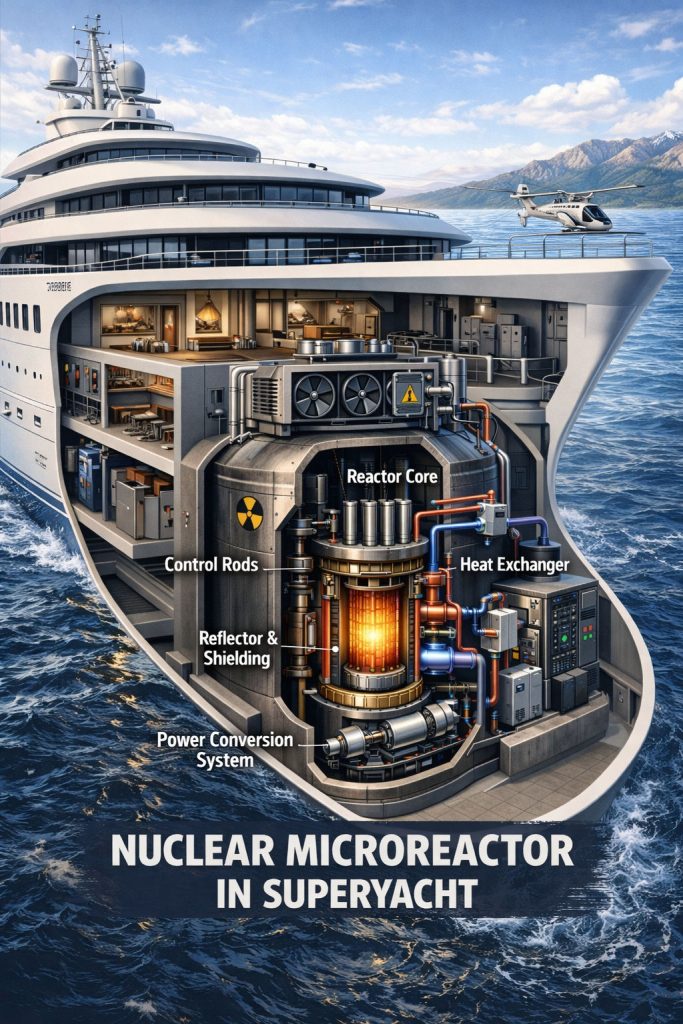
Transforming Maritime Energy with Scalable Nuclear Innovation
A Clean Maritime Future
The future of shipping is low-emission, high-efficiency, and flexible.
We’re already seeing:
- Electric tugboats
- Autonomous vessels
- Hydrogen ferries
- Carbon-neutral cruise ships
But range, reliability, and refueling are still major limitations.
Nuclear—specifically micro nuclear—removes those barriers.
It’s not science fiction. It’s not theory. It’s happening now.
Why Nuclear Works
Nuclear energy comes from the conversion of mass into energy—not chemical reactions. That means the energy density is orders of magnitude higher than fossil fuels.
A few kilograms of uranium can generate enough power to propel a ship around the world—multiple times.
And nuclear doesn't just reduce emissions—it eliminates them.
But what form does this energy take?
Heat, Then Power
Nuclear reactors produce heat—just like diesel engines do. That heat can be:
- Used to boil water and drive steam turbines (a proven and familiar tech)
- Converted to electricity for electric drives (in development)
- Integrated with hybrid or backup systems
Steam systems are mature, reliable, and adaptable. And electric drive integration is coming fast—opening even more options for fleet owners.
What About Green Fuels?
Let’s explore the alternatives.
Hydrogen
Hydrogen is often hailed as a miracle fuel. It’s clean, it burns to produce water, and it sounds futuristic.
But hydrogen is also:
- Highly flammable
- Difficult to compress and store
- Prone to leaking (it’s the smallest molecule on the periodic table)
- Expensive and inefficient to produce
Even with renewable energy powering its creation, hydrogen production, compression, and storage create an overall well-to-wheel energy loss approaching 50%. That’s a lot of waste in a system that’s supposed to be green.
Ammonia, E-Fuels, and Biofuels
These are essentially hydrogen carriers or fossil fuel alternatives created through complex chemical processes.
They often require:
- High energy inputs
- Specialized handling
- CO₂ emissions at some point in the cycle
- Complicated supply chains
They can work—but they’re not simple, and they’re not universally green. In many cases, these fuels shift the emissions burden upstream rather than eliminating it.
Fossil Fuels
Still the easiest option today. But the climate clock is ticking, and regulatory walls are closing in.
We can’t future-proof the fleet with yesterday’s energy.
From the NS Savannah to a New Era
In 1959, the NS Savannah became the first nuclear-powered commercial cargo ship. Though removed from service in 1972, its nuclear systems remained onboard until 2022—over 60 years of obligation tied to a single ship.
For modern shipowners, that kind of legacy is unacceptable. Today’s maritime industry demands vessels that are sellable, upgradeable, and recyclable—not nuclear time capsules with multi-decade liabilities.
If nuclear power is to return to commercial shipping, it must come in a new form: one that’s scalable, safe, and seamlessly integrated into modern maritime operations.
That solution is micro reactors.
Why Micro Reactors Matter
Nuclear power has always offered impressive potential for maritime use:
- No dependence on fossil fuels
- No need for massive fuel storage
- Unmatched energy density
- Minimal refueling requirements
A single micro reactor can power a vessel for years without refueling. That opens the door to polar crossings, remote port independence, and new global trade routes—all without relying on fuel bunkering infrastructure.
But traditional nuclear power comes with heavy baggage:
- Complicated refueling logistics
- Intense regulatory scrutiny
- Highly specialized personnel
- Inflexible embedded systems
Micro reactors change the equation. These units are:
- Compact (some the size of a shipping container)
- Modular and swappable
- Designed for long intervals between maintenance
- Contained, safe, and scalable
- Built with commercial fuels and global safety standards
With micro reactors, we’re not asking ships to carry lifetime fuel commitments—we’re giving them energy independence with upgrade flexibility.
What Does a Nuclear Ship Need?
If we want nuclear power at sea, we must engineer for success from the start.
A viable shipping reactor should:
- Use commercial, minimally processed fuel
- Fit in a compact, replaceable unit
- Require refueling only during major overhauls
- Support ambient cooling in emergencies
- Be removable at decommissioning
- Be made of low-maintenance materials
- Integrate with existing port infrastructure
Some Small Modular Reactors (SMRs) meet these criteria—but many are too large. Micro reactors are more promising, especially when paired with electric propulsion and containerized designs.
What Happens If Something Goes Wrong?
This is the heart of nuclear concern. So let’s be direct.
All modern nuclear designs—especially micro reactors—are built to shut down by default in the event of an emergency.
Here’s how different systems handle failures:
Water-Cooled Reactors
- If a pipe breaks, steam is vented
- Additional water can be pumped in
- Systems are familiar and manageable at sea
Gas-Cooled Reactors
- Inert gases like helium can be vented and replaced
- Less corrosive, but newer and less widely deployed
Molten Salt Reactors
- Still experimental
- Salt is corrosive and reacts poorly with water
- Riskier at sea, though potentially viable in the future
The best option? Proven technology, built with containment, cooling, and human safety in mind.
Learn from the Past
Many startups are promoting “new” reactor designs—but most are simply refinements of older models.
And that’s a good thing.
We don’t need to reinvent nuclear. We need to implement it responsibly, drawing from 70+ years of global reactor experience.
Chernobyl? Not the same technology. But the memory lives on.
That’s why micro reactor companies must earn trust through transparency, safety testing, and smart deployment—not marketing buzz.
Build the Ship, Then Install the Power
Here’s the biggest shift micro reactors allow:
You can build the ship before the nuclear system is ready.
How?
Design the vessel with a modular power bay—a containerized space that can accept a micro reactor or green fuel generator. This means:
- Ships stay in service
- Fleets stay flexible
- Early adopters avoid downtime
- Energy systems evolve independently of ship design
Just like we use interchangeable shipping containers to move cargo, we can use interchangeable power containers to drive ships.
What Will It Take?
For the industry:
- Visionary shipowners willing to test and invest
- Shipyards that integrate modular systems
- Crews trained on new safety protocols
- Ports that allow nuclear-capable docking
- Regulators open to performance-based safety certification
For technology providers:
- Practical, scalable micro reactor designs
- Safety by design—not by regulation alone
- Manufacturing pipelines that support demand
- Partnerships with maritime OEMs and operators
Ready to Rethink Maritime Energy?
Let’s lead the next generation of clean, reliable maritime propulsion—together.
If you're in the shipping, shipbuilding, port operations, or maritime energy sectors, let's talk.
It’s time to bring nuclear back to sea—smarter, safer, and smaller.