

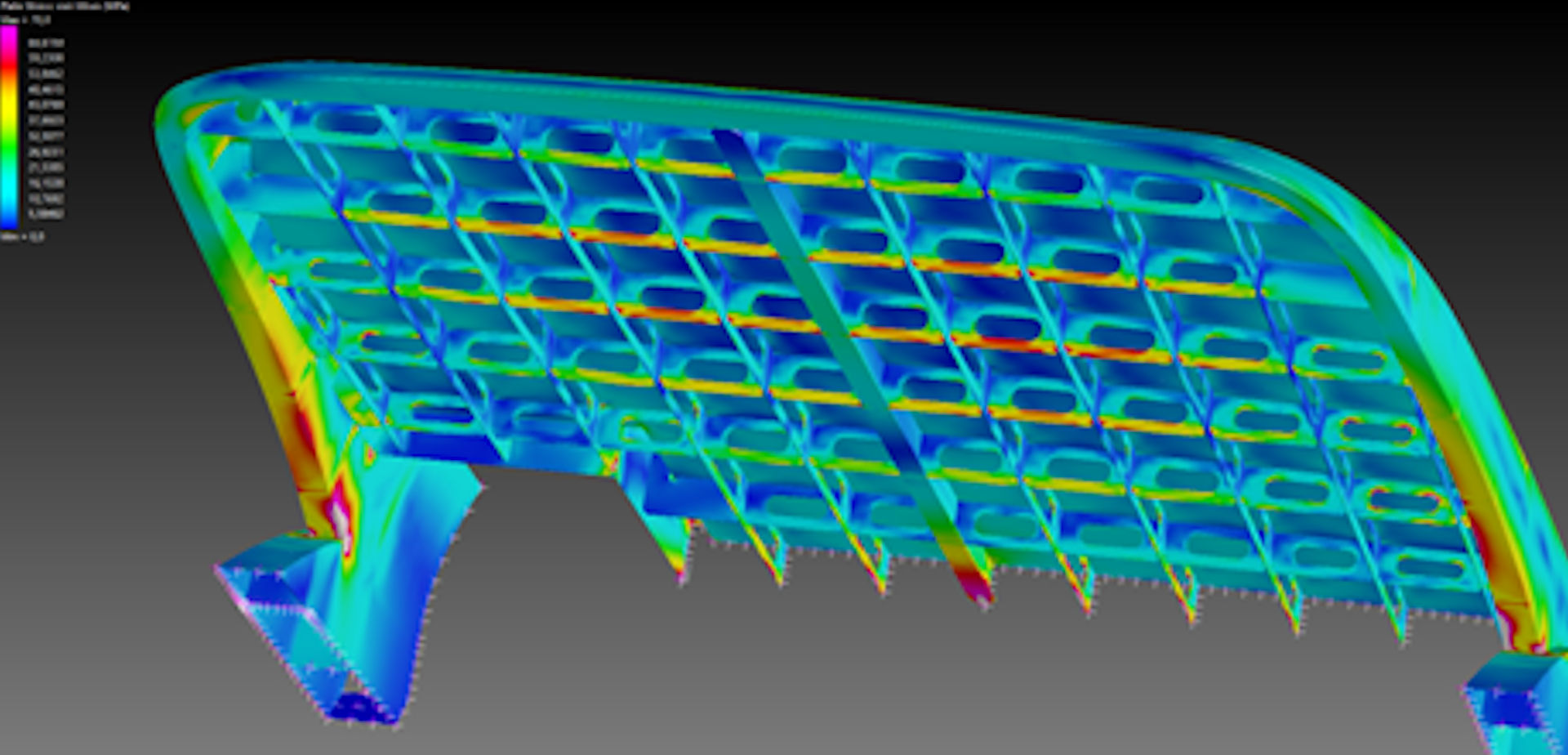
Finite Element Analysis (FEA) is often associated with one main objective: making structures strong enough while keeping weight under control. And rightly so. For naval architects, understanding structural strength is essential to creating safe, efficient and reliable vessels.
But strength is only part of the story.
As vessels become more advanced and increasingly rely on electronics, sensors and automated systems, the way we approach structural engineering needs to evolve. It is no longer enough to ask whether a structure can withstand a load. We also need to understand how it behaves, how it transmits vibrations, and whether the systems installed on board will continue to function when conditions become demanding.
At Catran Naval Architects, we use FEA not only to optimise structural strength, but also to assess and improve the dynamic behaviour of vessels. This becomes particularly relevant as unmanned surface vessels continue to develop and the demands on their platforms increase.
A Strong Structure Is Only the Starting Point
Traditional structural analysis often begins with a straightforward question: will the structure withstand the expected loads?
FEA allows us to investigate this in detail, identifying stress concentrations, evaluating deformations and finding opportunities to reduce structural weight without compromising strength.
However, a structure can be strong enough and still cause problems.
A vessel may experience excessive vibration around a sensitive sensor installation. A machinery foundation may amplify an excitation instead of isolating it. A structural panel may resonate at a frequency that affects equipment performance. Under shock loading, accelerations transmitted through the structure may exceed the limits of the systems mounted on it.
In these situations, the structure has not necessarily failed, but the vessel may no longer perform as intended.
This is why we believe structural engineering should look beyond strength alone. The real objective is to create a platform that performs reliably throughout its intended operating conditions.
Understanding Natural Frequency and Forced Vibrations
Every structure has natural frequencies: frequencies at which it tends to vibrate when disturbed. These depend on factors such as geometry, material properties, mass, stiffness and boundary conditions.
Problems can arise when the natural frequencies of a structure coincide with excitations from engines, propellers, rotating machinery or other sources. This can lead to resonance, amplifying vibration and potentially increasing fatigue damage or affecting sensitive equipment.
With modal analysis, we can predict the natural frequencies and associated vibration modes of a structure. This helps identify potential problems early in the design process, when changes are generally easier and less costly to implement.
Forced vibration analysis takes the investigation a step further. Rather than simply identifying how a structure naturally vibrates, we assess how it responds to specific forces across a range of operating frequencies.
This allows us to investigate questions such as:
- Will machinery vibrations be amplified by the supporting structure?
- Could vibration levels affect sensitive sensors or other onboard equipment?
- Can a foundation, support or structural arrangement be modified to improve performance?
- Is there a risk of excessive vibration during a particular operating condition?
The answers can guide practical design decisions, from adjusting structural stiffness and mass distribution to improving equipment foundations and mounting arrangements.
The goal is not simply to make a structure stiffer or heavier. It is to achieve the right dynamic behaviour for the application.
When Conditions Become More Demanding: Shock and Air Blast
Not every load develops gradually. Some events introduce sudden, intense loads that cause a structure to respond very differently from how it behaves under normal operating conditions.
Shock analysis investigates the response of a structure to short-duration, high-acceleration events. Depending on the application, these may include impacts, rapid mechanical events or specified shock environments.
Air blast loading introduces another challenge. A pressure wave can cause rapid structural deformation and transmit significant accelerations through a vessel and its equipment foundations.
In these situations, we need to consider more than peak stress. The duration of the load, structural deformation, acceleration levels and the response of connected components can all influence whether the vessel and its equipment remain functional.
FEA can help assess these responses and identify where improvements may be required. Depending on the scenario, this may involve transient dynamic analysis, nonlinear material behaviour or more specialised simulation methods.
The appropriate approach depends on the loading conditions, required performance criteria and level of detail needed. Good engineering starts by defining those requirements correctly.
Why This Matters for Unmanned Surface Vessels
The development of unmanned surface vessels (USVs) changes the way we think about vessel performance.
On a conventional vessel, the operating envelope is partly defined by the people on board. Human comfort, fatigue, accessibility and safety influence design decisions and can limit the conditions in which a vessel can reasonably operate.
With an unmanned vessel, some of these human constraints are reduced or removed. The platform may be designed to operate for longer periods, in more demanding environments or under conditions that would be unsuitable for a crewed vessel.
But removing the human from the vessel does not remove the limitations. It shifts them.
The platform, its propulsion system, power supply, communications, navigation equipment and sensors become critical to the vessel's ability to perform its mission. If a sensor is disrupted by excessive vibration, if a connection is damaged by shock, or if a structural response affects the accuracy of a measurement, the vessel may lose an essential capability without suffering a major structural failure.
This makes the relationship between structural design and system performance increasingly important.
For USVs, the question is therefore not only whether the vessel can survive its operating environment. It is whether the platform can support its systems within their prescribed operating limits, allowing them to do their job reliably.
Designing for Performance When It Counts
The most effective time to investigate these challenges is during design, before the structure and equipment arrangement are fixed.
By combining structural strength assessments with natural frequency, forced vibration and, where required, shock and air blast analyses, we can identify potential limitations and evaluate possible solutions early.
This may mean changing a local structural arrangement, modifying a foundation, adjusting mass distribution or reconsidering the position and support of sensitive equipment. Each decision should be based on the specific performance requirements of the vessel and the systems it carries.
At Catran Naval Architects, we have in-house tools to perform these assessments using FEA, including Strand7 and SimScale for appropriate engineering applications. This allows us to investigate structural behaviour as part of the design process and work collaboratively with clients, yards and system suppliers to develop practical solutions.
Our aim is not to add complexity for its own sake. It is to understand where the real limitations lie and address them before they become problems in operation.
Keeping the Vessel Performing When Things Go Wrong
A successful vessel design is not simply one that meets its requirements on paper under normal conditions. It is one that has been engineered with a clear understanding of the conditions it may encounter and the performance it must maintain.
As unmanned vessels take on more demanding roles, this broader approach to structural engineering will become increasingly important. Strength remains fundamental, but vibration, shock response and the protection of critical systems deserve equal attention wherever the operating environment demands it.
At Catran Naval Architects, we believe good engineering means looking at the complete picture: the structure, the systems and the mission they need to fulfil together.
Because when it counts, a vessel needs to do more than stay in one piece.
It needs to perform — and keep performing when things go bad.
Catran Naval Architects — Vision to Legacy.